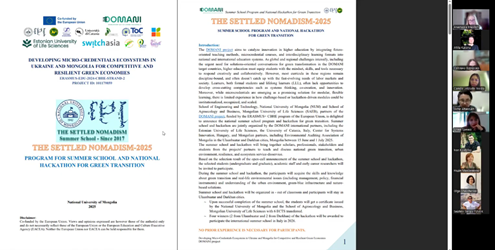
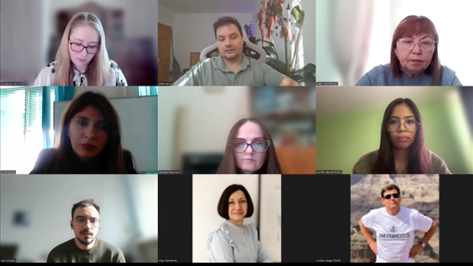
As part of the DOMANI project’s capacity-building activities, an online training session was held for Ukrainian partners on Wednesday, March 4, 2026, to introduce the hackathon methodology as a tool for challenge-based learning. The training was guided by Attila Katon, Director of the Center for Systems Innovation, while practical insights from implementation in Mongolia were shared by Agi Altansukh Ochir. The session brought together academic staff and facilitators to explore how hackathons can be adapted from their original roots in software development into flexible educational formats focused on sustainability and societal challenges.
The training highlighted the key components of a successful hackathon. Participants learned the importance of setting a clear timeline, forming collaborative teams, and defining engaging challenges. A strong emphasis was placed on allowing students to take ownership of these challenges by researching, reframing, and shaping them according to their interests, thereby increasing motivation and creativity throughout the process.
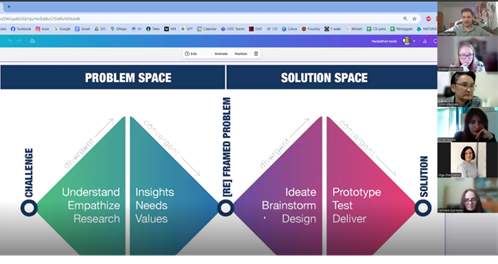
A structured workflow developed within the DOMANI project was presented, guiding participants through the main phases of a hackathon. These include challenge identification, research and problem definition, ideation, and solution refinement. Mentorship was identified as a critical element, with facilitators providing ongoing feedback to teams as they develop their ideas and move toward feasible and impactful solutions.
The session also introduced practical approaches to solution development and presentation. Rather than fully developed prototypes, participants are encouraged to create visualizations such as mock-ups, wireframes, or simple digital designs. These outputs support the final stage of the hackathon, where teams deliver short, focused pitches presenting their ideas, expected impact, and implementation approach.
To support implementation, real-world examples were shared, including an online European hackathon format and a hybrid summer school and hackathon organized in Mongolia. These cases demonstrated how hackathons can be adapted to different contexts and formats while maintaining their core objective: fostering collaboration, innovation, and practical problem-solving skills among students.
Reported by:
Center for Systems Innovation