
Between August 11 and 13, 2025, the DOMANI project consortium convened at Central European University in Budapest for an intensive three-day writeshop dedicated to developing and refining the DOMANI Competency Framework. This hybrid collaborative event brought together a total of 25 participants – 17 attending onsite in Budapest and 8 joining online. Work package leads, academic staff, communication focal points, and invited experts from partner universities across Europe and Asia, including Estonian University of Life Science, Estonian Education and Youth Board, University of Catania, Center for Systems Innovation, Taras Shevchenko National University of Kyiv, V. N. Karazin Kharkiv National University, National University of Mongolia, and Mongolian University of Life Sciences. The external Quality Assurance officer and representatives from multiple work packages also participated, ensuring comprehensive input from all project dimensions.
The writeshop’s primary objective was to co-design a robust competency framework that would serve as the foundation for DOMANI’s educational offerings in digital transformation, sustainability, and systems innovation. As tomorrow’s sustainability leaders require more than passion, they need systems thinking, digital fluency, collaborative capacity, and deep thematic expertise to address complex global challenges. The DOMANI Competency Framework was designed to capture these essential dimensions and provide a structured pathway for curriculum development, mentorship programs, and microcredential provision across all partner institutions.
Over three days of intensive collaboration, participants engaged in comparative framework analysis, breakout discussions, use-case validation sessions, and iterative co-design workshops. The team examined existing frameworks including DIGCOMP, GREENCOMP, and ENTRECOMP, extracting relevant dimensions while ensuring the DOMANI framework remained contextually appropriate for partner countries and thematically aligned with the project’s sustainability and innovation focus.
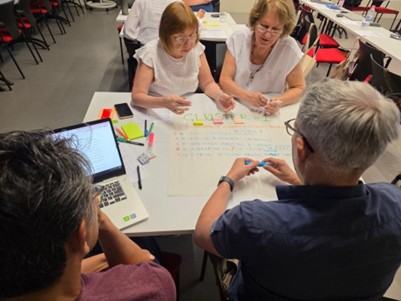
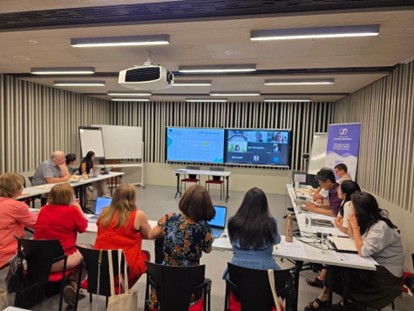
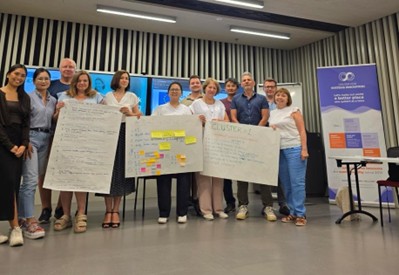
The writeshop achieved significant milestones. Partners established a comprehensive framework structure comprising three core competency clusters, Sustainability Mindset & Systems Thinking; Digital Competence & Communication for Sustainability; and Collaboration & Action, plus a fourth DOMANI thematic cluster allowing for contextual, partner-driven specializations. From an initial list of 32 competencies, participants prioritized 12 for immediate piloting and curriculum mapping. Critically, all competencies were expressed using a consistent Knowledge-Skills-Attitudes (K/S/A) format, enabling systematic assessment and curriculum alignment across diverse institutional contexts.
Beyond formal working sessions, participants strengthened partnerships through cultural and social activities that enriched the collaborative spirit of the event. The group explored Budapest together through city walks, enjoyed an evening dinner at the scenic Kopaszi-gát waterfront, attended an opera performance, and ventured into the Pálvölgyi Cave system with the CSI team, a refreshing escape from the summer heat that fostered informal networking and deeper connections among partners.
The DOMANI Competency Framework version 1.1 is now being consolidated for circulation to all partners, with official publication anticipated in late 2025. Immediate next steps include course-to-competency mapping exercises at partner institutions and preparation for pilot implementation across multiple countries. This framework will serve as the cornerstone for educating the next generation of sustainability and digital transformation leaders equipped to address the complex challenges facing our world.

Reported by:
Center for Systems Innovation